1780s: Founding and the Rejection of Monarchy
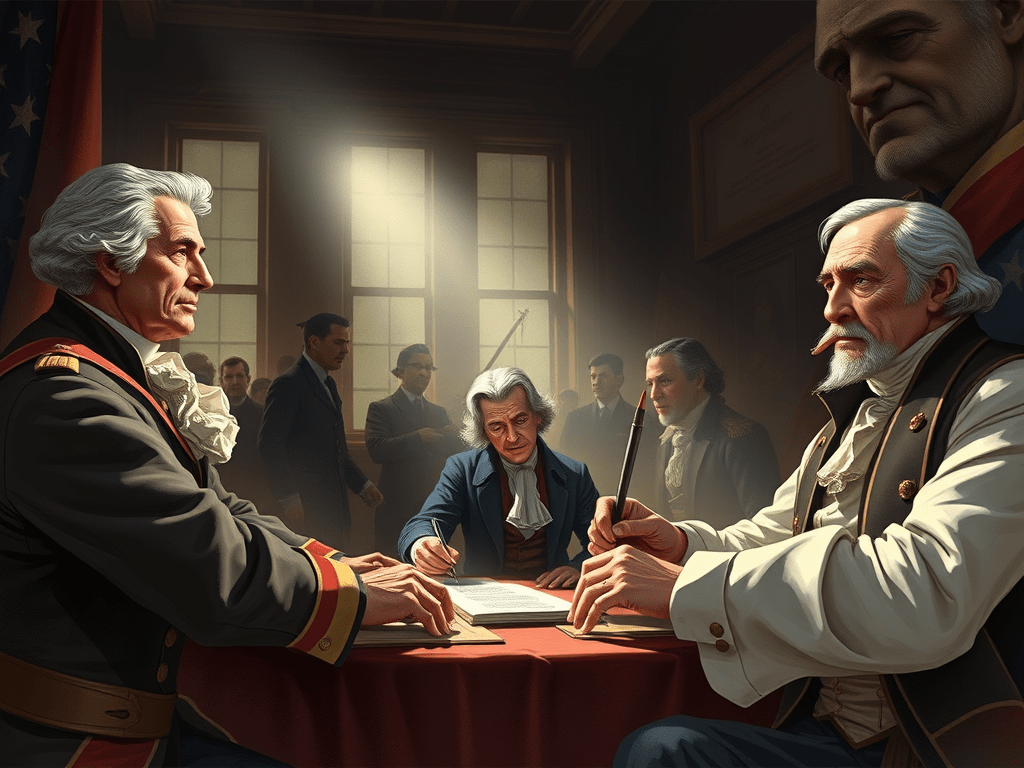
In the aftermath of the Revolutionary War, some Americans flirted with the idea of a monarchy or military dictatorship. Frustrated Continental Army officers in 1783 (the Newburgh Conspiracy) even suggested George Washington seize power. Washington pointedly refused and instead resigned his commission, establishing the vital precedent of civilian control of the military.
This self-restraint set the young republic apart from revolutions that ended in dictatorships. As Thomas Jefferson observed, Washington’s “moderation and virtue” likely prevented the Revolution from closing “by a subversion of that liberty it was intended to establish”.
By stepping down from the presidency in 1797 after two terms, Washington again rejected autocracy, laying a cornerstone for U.S. constitutional governance.
1798: The Alien and Sedition Acts – Early Authoritarian Tendencies
Only a decade into the Constitution, the administration of President John Adams pushed the limits of democratic norms. Amid a quasi-war panic with France, Adams signed the Alien and Sedition Acts (1798), which empowered the government to deport “dangerous” foreigners and criminalized criticism of the government.
Over 20 opposition newspaper editors were arrested under the Sedition Act, and even a Congressman (Matthew Lyon) was jailed for insulting the President. These laws “clearly violated” First Amendment protections and were denounced by Thomas Jefferson and James Madison as tyrannical. Virginia and Kentucky passed resolutions nullifying the acts, a bold states’ rights challenge that “pointed toward imminent armed conflict within the United States”.
Although the crisis subsided with the election of 1800 (when Jefferson defeated Adams and allowed the Acts to expire), the episode marked the new nation’s first brush with authoritarian rule, demonstrating how easily security fears could curtail liberty.
1829–1837: “King Andrew” and Jackson’s Concentration of Power
President Andrew Jackson’s forceful leadership style in the 1830s sparked accusations of autocracy. He wielded the veto more frequently and for policy disagreements (not just constitutionality), asserting executive prerogative in unprecedented ways.
Jackson defied a Supreme Court order in Worcester v. Georgia (1832), refusing to enforce Chief Justice Marshall’s ruling protecting Cherokee sovereignty.
His disregard for judicial authority and aggressive use of executive powers alarmed opponents. Whigs scornfully caricatured him as “King Andrew I,” portraying him as a monarch trampling the Constitution.
This nickname reflected widespread fears of an overly powerful presidency – Jackson’s critics saw his “king-like” tendencies as a threat to the balance of powers.
Indeed, the U.S. Senate formally censured Jackson in 1834 over his removal of federal deposits from the Bank of the U.S., a reprimand signaling concern that he had exceeded his authority. Jackson’s popular mandate and force of personality allowed him to push boundaries, testing how far an elected president could go toward centralized, personal rule before provoking institutional backlash.
1861–1865: Civil War Emergency – Lincoln’s “Constitutional Dictatorship”
The Civil War plunged the nation into an existential crisis, during which President Abraham Lincoln assumed extraordinary powers to save the Union. He suspended the writ of habeas corpus by executive order (without Congress at first), allowing indefinite detention of suspected rebels and dissenters. Thousands were arrested without trial, and some critical newspapers were shuttered by military order. Critics in Lincoln’s day accused him of being a tyrant; Northern opponents regularly lambasted “Dictator Lincoln,” with one Wisconsin editor even calling for Lincoln’s assassination as a “tyrant”.
Modern scholars note that Lincoln “increased his powers in wartime until he became ‘an omnipotent, national executive…entitled to do whatever he felt was good for the nation’”
This concept of a “constitutional dictatorship” (temporary emergency autocracy) was hotly debated. Lincoln justified his controversial acts as necessary to preserve the republic—famously asking whether a nation must allow itself to be destroyed just to honor one law (habeas corpus). Notably, elections continued during the war (Lincoln stood for reelection in 1864 and would likely have relinquished power had he lost). Ultimately, Union victory restored normal constitutional order. Yet the Civil War revealed that even a democratically elected leader could amass near-dictatorial authority amid an emergency, raising enduring questions about the balance between survival of the state and civil liberties.
1876–1877: The Disputed Election and Political Standoff
The presidential election of 1876 brought America to the brink of constitutional breakdown. Results in several states were contested between Republican Rutherford B. Hayes and Democrat Samuel Tilden, with rampant accusations of fraud. Multiple slates of electoral votes were submitted, and no clear winner emerged on election night.
As inauguration day neared, the nation faced an “unprecedented constitutional crisis,” with the very process of transferring power in doubt.
Partisans in Congress threatened to reject each other’s electoral votes, raising the specter of dual claimants to the presidency. To avert chaos, Congress established a special 15-member Electoral Commission in early 1877 to decide the outcome.
After a tense impasse, a backroom compromise was struck: Hayes received the disputed electoral votes (and thus the presidency) in exchange for the end of Reconstruction (the withdrawal of federal troops from the South). This Compromise of 1877 resolved the crisis peacefully, but at a heavy cost to Black civil rights in the South. Observers at the time recognized how close the country came to disaster – without the deal, the standoff might have escalated to violence or extra-constitutional power grabs. Indeed, President Ulysses S. Grant had quietly readied troops in case the deadlock led to unrest in Washington. The 1876–77 crisis underscored the fragility of the electoral process and was arguably the greatest strain on U.S. constitutional governance between the Civil War and the Civil Rights era. It was only through a last-minute political bargain that a genuine breakdown (or de facto coup) was averted.
1917–1919: World War I and Wartime Repression
During World War I, the U.S. government again pushed against constitutional guardrails in the name of security. Under President Woodrow Wilson, Congress passed the Espionage Act (1917) and Sedition Act (1918), criminalizing a broad range of anti-war speech and dissent. Over 2,000 people were prosecuted, and socialist leaders like Eugene V. Debs were imprisoned simply for speaking against the war. (Debs received a 10-year sentence for a single anti-war speech, under laws that made opposition to the war effort illegal) The Wilson administration also condoned the notorious Palmer Raids (1919–20), in which federal agents rounded up thousands of suspected radicals without due process during the First Red Scare. These measures effectively suspended core civil liberties – one historian noted that Wilson’s crackdown was “notoriously” oppressive.
While the U.S. did not cancel elections or posit a dictator in this period (Wilson duly faced voters in 1916 and 1920), the climate was undeniably authoritarian. Free speech and press were muzzled, and the administration assumed broad powers over the economy and society under the war emergency. The excesses were later rolled back – Debs, for instance, was released in 1921 – but WWI set a precedent that in wartime, American democratic norms could be severely curtailed, approximating the tactics of the very autocracies the U.S. opposed abroad.
1933: The Business Plot – A Plan to Install a Dictator
The Great Depression brought social upheaval and even talk of dictatorship to America. In 1933, a group of wealthy businessmen and financiers angered by Franklin D. Roosevelt’s New Deal allegedly conspired to overthrow the elected government. This “Business Plot” envisioned recruiting a well-regarded general to lead a coup d’etat and establish an authoritarian regime friendly to business interests.
Retired Marine Corps General Smedley Butler was approached to head a 500,000-man army of veterans that would seize Washington, D.C. and install him (and the plotters behind the scenes) in power. Butler instead blew the whistle – in November 1934, he testified to Congress about the plot, exposing its leaders and imploding the scheme
A congressional committee found the allegations credible, though no one was prosecuted. The Business Plot ultimately fizzled, but it stands as a chilling moment when elements of the elite considered scrapping democracy entirely. Historians note it “represented a genuine attempt at dictatorship in American political history”, even if doomed by the conspirators’ poor choice of ally (the fiercely patriotic Butler) and lack of mass support
The incident, long obscure, has gained attention as a reminder that even in the United States, a coup attempt – however far-fetched – was contemplated during a time of severe economic and political stress.
1933–1945: FDR’s Presidency and Consolidation of Power
Franklin D. Roosevelt’s four terms (1933–1945) saw an unprecedented accumulation of executive power in response to national crises. Confronting the Depression and World War II, FDR vastly expanded the reach of the federal government and the presidency. Many New Deal programs skirted or pushed constitutional boundaries, prompting the Supreme Court to strike down several early initiatives. Roosevelt’s response was the infamous “court-packing” plan of 1937 – he proposed adding additional justices to the Supreme Court to secure a pro-New Deal majority. This blatant attempt to bend an equal branch of government to his will alarmed observers across the political spectrum. By the middle of his second term, “much criticism of Roosevelt centered on fears that he was heading toward a dictatorship” through schemes like court-packing and purging opponents in his own party.
FDR’s bid to enlarge the Court was defeated by Congress and public opinion, but the episode cemented worries that he sought to dominate all branches of government. Those fears resurfaced when Roosevelt broke the two-term tradition and ran for a third term in 1940 (and even a fourth in 1944). Opponents argued it was time to “disarm the ‘dictator’ and dismantle the machinery” of unlimited tenure, and after FDR’s death the 22nd Amendment was passed to constitutionally limit presidents to two terms.
During World War II, Roosevelt wielded extraordinary powers as Commander-in-Chief. While he successfully guided the nation to victory, some actions veered into authoritarian territory. Most notoriously, FDR authorized the mass internment of Japanese Americans in 1942. By executive order, over 110,000 people (mostly U.S. citizens) were forced into camps without trial, due solely to their ethnicity – a policy the government itself later acknowledged stemmed from racial fear rather than military necessity.
This suspension of habeas corpus and property rights for an entire minority group is widely viewed as a grave abuse of executive power. In effect, constitutional protections were set aside by fiat, a scenario one would expect under a dictator, not an American president. The Supreme Court’s wartime validation of the internment (Korematsu v. United States, 1944) further illustrates how checks on the executive can fail under extreme stress. While American democracy ultimately resumed its normal course after 1945 (the camps were closed, and FDR’s successors relinquished emergency powers), the Roosevelt era demonstrated both the necessity and the danger of a powerful presidency. His leadership helped save democracy globally, even as his unprecedented tenure and actions at home spurred lasting safeguards (like term limits) against executive excess.
1950–1954: McCarthyism and the Red Scare
In the early Cold War, the United States experienced an internal crackdown on dissent that resembled authoritarian tactics. The Second Red Scare, peaking between 1950 and 1954, saw Senator Joseph McCarthy and others launch a witch hunt for communist subversives throughout American institutions. Fueling a “fever pitch” of paranoia, McCarthy wielded accusations as a political bludgeon, ruining careers and chilling free expression. Congressional committees (HUAC in the House and McCarthy’s Senate investigations) hauled in citizens and officials to confess associations or name names, often with scant evidence. The atmosphere was one of fear and conformity – “McCarthy’s…fear-mongering created a climate of fear and suspicion across the country. No one dared tangle with McCarthy for fear of being labeled disloyal”.
Though McCarthy held no executive office, his outsized influence and demagogic methods posed a serious threat to democratic norms. Dissenting political views (even mild progressive leanings) were equated with treason. Free speech was stifled as teachers, writers, and actors were blacklisted. The executive branch, under Presidents Truman and Eisenhower, was often complicit or timid; loyalty oaths were imposed on government workers, and Eisenhower initially avoided directly confronting McCarthy’s abuses. This period is sometimes called a “soft” or creeping American authoritarianism, in that the forms of democracy (elections, courts, Congress) persisted, but the spirit of liberty was under siege. The Red Scare only relented after McCarthy overreached by attacking the Army, leading to his public disgrace in the 1954 Army-McCarthy hearings and a Senate censure. The episode stands as a caution that democratic institutions can be subverted from within by demagogues who manipulate fear – a scenario not unlike how authoritarian regimes take root. It took courageous journalists like Edward R. Murrow, and eventually the Senate itself, to break the spell and reassert constitutional values.
1972–1974: Watergate and the “Imperial Presidency”
The Watergate scandal of the early 1970s represented a direct assault on the rule of law by President Richard Nixon and his aides, bringing America to a constitutional precipice. Nixon’s reelection team authorized illegal break-ins and political espionage against opponents, then the President orchestrated a massive cover-up that subverted justice. For two years, Watergate revelations “convulsed the nation in a series of confrontations that pitted the President against the media, executive agencies, the Congress, and the Supreme Court”
Nixon abused executive power to target “enemies” – using the FBI, CIA, and IRS against critics – and claimed virtually uncheckable authority. He famously stated, “When the President does it, that means it is not illegal,” reflecting an autocratic view above the law. The constitutional crisis climaxed in 1973–74: after Nixon defied subpoenas for White House tapes, the Supreme Court unanimously ordered him to comply. In October 1973’s “Saturday Night Massacre,” Nixon fired the special prosecutor investigating him (and forced out the top two Justice Department officials) in an attempt to halt the inquiry, sparking public outrage and comparisons to authoritarian purges. The drama validated historian Arthur Schlesinger Jr.’s warning of an “Imperial Presidency,” where the executive had accumulated dangerous power since the 1930s.
As impeachment loomed in 1974, there were quiet fears Nixon might refuse to relinquish office or even try to use the military to hold power. Defense Secretary James Schlesinger was so concerned about Nixon’s mental state in his final days that he instructed military commanders not to execute any presidential order (especially a nuclear launch) without consulting him or the Secretary of State first.
This extraordinary step – essentially having the Pentagon second-guess the commander-in-chief – underscored how close to the brink things came. Ultimately, however, the rule of law prevailed: Nixon complied with the Supreme Court, the House Judiciary Committee approved articles of impeachment, and on August 9, 1974, Nixon resigned rather than be removed. It was a moment of vindication for constitutional checks and balances. As the National Archives later noted, “The Watergate affair was a national trauma – a constitutional crisis that tested and affirmed the rule of law.”
In response, Congress enacted reforms (like the War Powers Act and stronger ethics laws) to rein in executive abuses. Watergate thus highlighted both how a president could endanger democracy and how a robust system, if people of integrity stand firm, can correct itself before tipping into actual dictatorship.
1985–1987: The Iran-Contra Scandal and Secret Government
In the 1980s, the Reagan Administration became embroiled in the Iran-Contra affair, a covert operation that bypassed democratic oversight and violated the law. Senior officials secretly sold arms to Iran (then under an arms embargo) and funneled the proceeds to the Contra rebels in Nicaragua – defying a congressional ban on funding that war. When the scheme came to light in late 1986, it exposed a shadow foreign policy run out of the White House basement, with lies told to Congress and official documents shredded to hide the trail. The scandal amounted to an executive branch conspiracy to nullify laws it disagreed with, raising a profound constitutional challenge. One historian called Iran-Contra “the most significant constitutional crisis since Watergate”.
Televised congressional hearings in 1987 laid bare the extent of the deceit, featuring figures like Lt. Col. Oliver North admitting to shredding evidence and setting up off-the-books networks. There was even “serious talk of impeachment” of President Ronald Reagan during this period, though ultimately Reagan claimed ignorance of the operation’s illegality and escaped direct culpability.
The Iran-Contra affair showed an administration operating in almost monarchial secrecy, convinced its ends (fighting communism) justified illegal means. By arrogating war-and-peace decisions to a small circle, it bypassed the Constitution’s assignment of those powers to Congress. In effect, it demonstrated how the executive might slide into authoritarian behavior under the cover of national security. Multiple officials were convicted of crimes (lying to Congress, destroying documents), though many were later pardoned. While the constitutional system again responded – through investigations and public accountability – the affair highlighted the ongoing tug-of-war between secrecy/power and transparency/rule-of-law. It underscored that even in a modern democracy, elements of an “imperial presidency” persisted, requiring vigilance to keep them in check.
2001–2008: Post-9/11 Emergency Powers and the Security State
The terrorist attacks of September 11, 2001 triggered a massive expansion of executive power and raised new alarms about the potential for authoritarian drift. President George W. Bush, initially coming into office after a controversial contested election in 2000, assumed “immense presidential emergency powers” following 9/11
With public opinion rallying around him, Bush and his advisers asserted sweeping authority to wage a new kind of war. Congress did grant specific powers (Authorization for Use of Military Force, USA PATRIOT Act), but the administration’s interpretation of its own powers went far beyond. The White House legal team advanced the “Unitary Executive Theory,” arguing that the President, as Commander-in-Chief, could “set aside laws, even criminal laws, that infringe on his view of executive power”
This theory, described by one scholar as “astounding” and in total contradiction to checks and balances was used to justify practices such as warrant-less surveillance of Americans, indefinite detention and torture of terror suspects, and bypassing of Congress’s war-making role.
In the ensuing “War on Terror,” hundreds of people (including U.S. citizens like José Padilla and Yaser Hamdi) were detained without charge as “enemy combatants.” The administration operated secret CIA prisons overseas and approved harsh interrogation methods widely deemed torture. It also engaged in extensive domestic eavesdropping without court warrants (exposed in 2005) in the name of security. Civil libertarians warned that these measures eroded the rule of law and mirrored behaviors of authoritarian governments. Courts did step in on a few occasions – for instance, the Supreme Court in Hamdan v. Rumsfeld (2006) rebuked Bush’s creation of military tribunals without congressional approval, and Hamdi v. Rumsfeld (2004) affirmed that even war detainees who are U.S. citizens have due process rights. But even with some judicial pushback, the post-9/11 era established a normalized state of exception. Some commentators openly worried that the U.S. was “lurching toward an imperial presidency, posing a direct threat to the essence of American liberty”.
The crisis atmosphere made expansive executive power politically palatable, recalling Roman dictatorships in times of peril (a parallel drawn by Vice President Dick Cheney in defending near-unchecked presidential prerogative). While the Bush administration did not cancel elections or seek to extend its term, it set precedents that future presidents could cite to bypass legal restraints. Indeed, elements of these powers (e.g. surveillance and drone strikes) continued under President Obama, showing how hard it is to roll back emergency authority once in place.
The 9/11 period thus represents a modern instance when Americans traded some freedom for security, and in doing so edged closer to the latitude of an autocrat in the White House.
2017–2021: The Trump Era and the 2020 Election Crisis
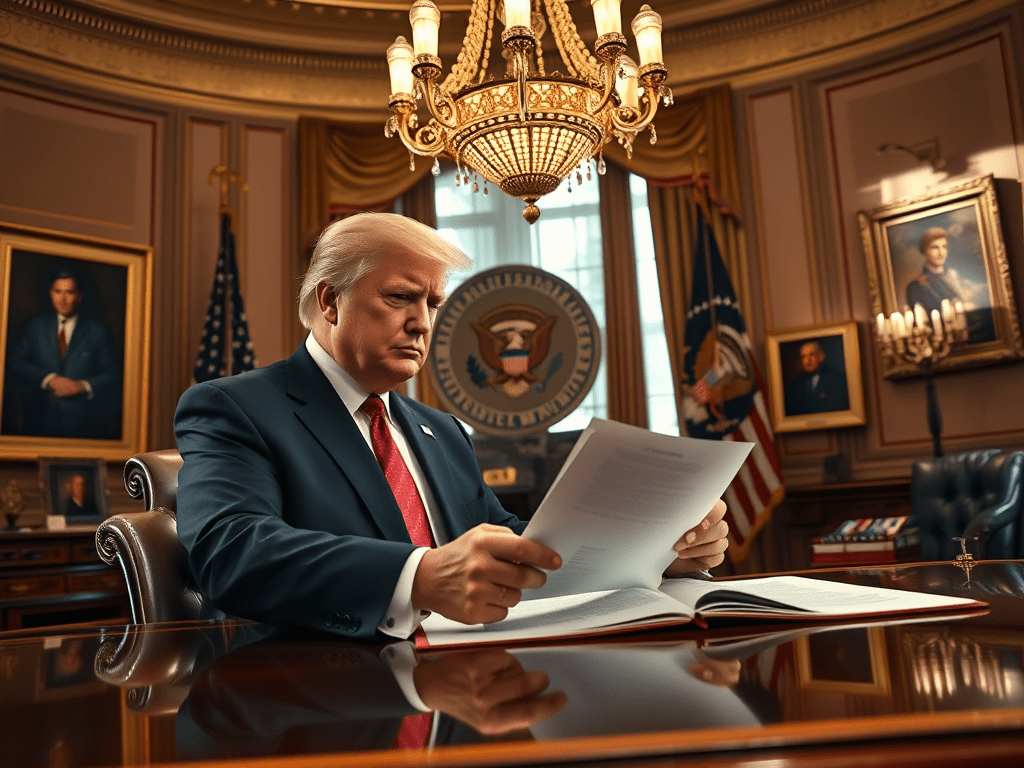
In recent years, many scholars and watchdogs have pointed to the administration of President Donald J. Trump as a time when the United States came alarmingly close to democratic erosion – even outright autocracy. From 2017 onward, Trump exhibited open disdain for institutional checks, norm-breaking behavior, and open admiration for foreign strongmen. He frequently attacked the press as the “enemy of the people,” undermining a cornerstone of democracy. He assailed judges who ruled against him and purged independent-minded inspectors general and Justice Department officials, attempting to bend law enforcement to his personal will. Trump’s first impeachment in 2019 reflected one such abuse of power: he was charged with extorting a foreign country (Ukraine) to smear a political rival, leveraging U.S. military aid for personal gain – an echo of authoritarian tactics where state resources are used to destroy opponents. Throughout his term, he pushed the boundaries of executive authority, for instance by diverting congressionally appropriated funds to build a border wall under a dubious “national emergency” declaration. He also mused publicly about serving beyond the constitutional limit of two terms and routinely cast doubt on the legitimacy of any election he did not win. All these moves prompted experts to warn that democratic norms were crumbling. As one historian put it, Trump was using “the classic elected authoritarian playbook” – undermining the press, politicizing the justice system, sowing distrust in elections – in ways unprecedented for a U.S. president.
The gravest threat came with the 2020 presidential election. Even before votes were cast, Trump asserted that the only way he could lose was if the election was “rigged.” When he did lose, he refused to concede, making false claims of mass fraud and pursuing dozens of lawsuits to overturn results (all rejected in court). Trump pressured state officials to “find” him votes and leaned on his own vice president to unilaterally reject electoral votes – schemes that had no legal basis. This campaign to subvert the vote culminated in the January 6, 2021 attack on the U.S. Capitol. Trump urged a large crowd of supporters to march on Congress as it met to certify Joe Biden’s victory, exhorting them to “fight like hell” to stop the transfer of power. The ensuing violent insurrection saw a mob storm the Capitol, threaten lawmakers, and temporarily halt the certification of the election – a shocking first in American history. Police officers were assaulted and the seat of government was occupied by insurrectionists carrying Confederate flags and even erecting makeshift gallows. Only hours later, after security forces regained control, did Congress reconvene to complete the count. The episode was widely described as an attempted self-coup by a sitting president. Had key institutions (from some Republican state officials and judges, to Vice President Pence and Capitol Police) not held firm, the United States could have experienced an unconstitutional power grab. Many observers openly called it the most severe crisis of American democracy since the Civil War.
Political experts warn that the Jan. 6 insurrection and the multi-pronged effort to overturn the 2020 election put the U.S. at genuine risk of authoritarian rule. “If what happened on Jan. 6 happened in any other country, we would have called that undemocratic,” one analyst noted, emphasizing that attempts to overturn a legitimate election “lead to authoritarian states”.
Indeed, for the first time, a U.S. president had disrupted the peaceful transfer of power – the hallmark of stable democracy. Even after leaving office, Trump and his allies have persisted in spreading the “Big Lie” of a stolen election, eroding public trust in the electoral system and laying groundwork to challenge future outcomes. The January 6th House Committee in 2022 gathered extensive evidence of Trump’s orchestration of these events, and some participants have been prosecuted for seditious conspiracy. President Biden has described this moment as a battle for “the soul of the nation,” arguing that American democracy faces an ongoing inflection point. International democracy monitors took note as well: in 2020, Freedom House downgraded the United States’ freedom rating, citing attacks on electoral legitimacy and governmental checks.
As of the most recent data, the United States remains a constitutional republic with President Biden in office, but the trauma of 2020–21 has not fully abated. Experts continue to stress how close the country came to a serious democratic breakdown. The guardrails ultimately held – courts rejected baseless fraud claims, military and federal agencies did not intervene on Trump’s behalf, and Congress reconvened to certify the vote – but it was a near miss. America, they warn, cannot be complacent. The pattern of events resembled the “slow-motion train wreck of American authoritarianism” that many feared
The lesson of this period is that even a long-standing democracy can teeter toward autocracy if enough leaders and citizens are willing to cast aside norms and the rule of law.
Conclusion: Resilience and Vigilance
Over the course of U.S. history, these episodes illustrate that the threat of autocracy is not abstract – it has surfaced repeatedly, from the 18th century to the 21st. Each time, a combination of institutional checks, public outcry, and often sheer luck prevented a slide into dictatorship. Washington’s integrity set a standard that power must yield to principle. Adams’s repressive laws were answered by electoral defeat. Jackson’s audacity was balanced by an emerging opposition party and the constitutional structure. Lincoln’s extraordinary measures, taken to save the Union, were bounded by his own commitment to elections and eventual court interventions. The 1876 crisis was resolved by compromise rather than force. Wilson’s and later McCarthy’s crackdowns ended when wars and panics subsided, and cooler heads restored liberties. Nixon’s overreach was met with impeachment moves and resignation, and Reagan’s scandal with investigations and reforms. Even the post-9/11 drift toward an “imperial presidency” was mitigated by judicial and media scrutiny and the American public’s eventual fatigue with war. And in the showdown of 2020–21, the Constitution proved bruised but not broken – a peaceful transfer did occur, and the plot to subvert the vote failed
Crucially, in each instance people made the difference – whether it was generals refusing illegal orders, officials testifying to Congress, voters ejecting would-be authoritarians, or judges and legislators holding the line. History shows that U.S. democracy’s survival has never been automatic. It has depended on leaders respecting norms and the governed remaining watchful. While the United States has thus far averted permanent autocracy, these close calls serve both as warnings and inspiration. They highlight the need for constant vigilance, robust institutions, and a citizenry committed to constitutional ideals. As the nation moves forward, understanding these historical moments is vital to ensuring that “government of the people, by the people, for the people” never perishes by slipping into the hands of one man or a tyrannical few. Each generation must learn from the past to fortify democracy against the ever-present temptations of dictatorship.
Credits:
michiganadvance.com
american.edu
csmonitor.com
americanheritage.com
millercenter.org
socialstudieshelp.com
billofrightsinstitute.org
saturdayeveningpost.com
ushistory.org
archives.gov
politico.com
oah.org
millercenter.org
qz.com
en.wikipedia.org


 PSE Guide