Category: Legal

  • The Power of Words: How Leaders and Influencers Shape Culture, Economy, and Global Stability

    The Power of Words: How Leaders and Influencers Shape Culture, Economy, and Global Stability

    Words That Move Markets and March Troops

    In the world of politics, finance, and social influence, words are weapons, tools, and catalysts—all at the same time. Let’s take the example of President Barack Obama, who once said he was extremely careful with his words because, as he put it, “anything I say could send troops marching or markets tumbling.” This wasn’t just self-awareness—it was a reflection of the immense power that language holds.

    Fast forward to 2025, and we see this dynamic playing out in real-time. Take Donald Trump and Elon Musk, two of the most influential figures in politics and business today. Their words can cause markets to skyrocket—or crash. Their statements can reshape alliances or spark diplomatic crises.

    For example:

    • Trump’s Trade War Tweets (2018-2020): When President Trump would tweet about tariffs on China, the Dow Jones Industrial Average and global stock markets would respond within minutes—sometimes with billion-dollar swings.
    • Elon Musk’s Tesla and Crypto Influence: When Musk tweeted “Tesla stock price is too high imo” in 2020, Tesla’s shares immediately plummeted by $14 billion in market value. More recently, his posts about Bitcoin and Dogecoin have led to wild volatility in the crypto space.

    The 2025 Reality: The Cost of Unchecked Rhetoric

    This isn’t just about big finance and politics—it affects ordinary people. Imagine you’re a small business owner, an investor, or just someone trying to plan for the future. How do you operate in an environment where one unpredictable statement from a global leader could alter your financial security overnight?

    Some experts suggest that certain figures might even be profiting from the chaos—trading stocks before making statements that they know will impact the market. While there’s no definitive proof, this kind of market manipulation has been speculated about for years. The problem? The average person has no such power. They can’t adjust their finances on a whim, unlike billionaires or government insiders.

    How Rhetoric Shapes Culture, Security, and Global Peace

    But language doesn’t just move markets—it drives culture and security. Consider these examples:

    • War and Diplomacy: In 2003, the phrase “Weapons of Mass Destruction” (WMDs) led the U.S. into war with Iraq. Later, it was revealed that there were no WMDs—yet that rhetoric shaped global history.
    • The Social Media Effect: The 2021 Capitol Riot was fueled by false narratives about election fraud. Words—amplified through digital platforms—turned into real-world violence.
    • The Role of AI and Deepfakes: In 2025, misinformation spreads faster than ever. A manipulated video or AI-generated audio of a world leader making a false statement could start a financial panic or even trigger a military response.

    Can We Hold Powerful Voices Accountable?

    So, what’s the solution? Should there be regulations on how influential figures speak about markets, security, and international affairs? Should social media platforms have more control over misinformation? Or does that cross the line into censorship?

    Here’s what some experts suggest:

    1. Financial Transparency – Leaders and high-profile figures should disclose their market positions before making economic statements.
    2. Media Responsibility – News platforms need to provide more context and fact-checking before amplifying volatile statements.
    3. Public Awareness – We, as the audience, must be more critical of the information we consume and recognize when rhetoric is being used to manipulate.

    Conclusion

    “Language is power. Whether it’s a president, a billionaire, or an influencer with millions of followers—what they say matters. It shapes markets, relationships, and even national security. The next time you see a tweet, a speech, or a viral video from someone with influence—ask yourself: Who benefits from this message? And who might suffer?

  • Did Trump Serve as a KGB Recruit? Exploring Recent Claims

    Did Trump Serve as a KGB Recruit? Exploring Recent Claims

    A Shadow Over the Republic: The Unsettling Allegations Against Trump

    History has a way of whispering its warnings long before the storm arrives. And now, those whispers have turned into something more—a chilling accusation that, if true, would shake the very foundation of American democracy.

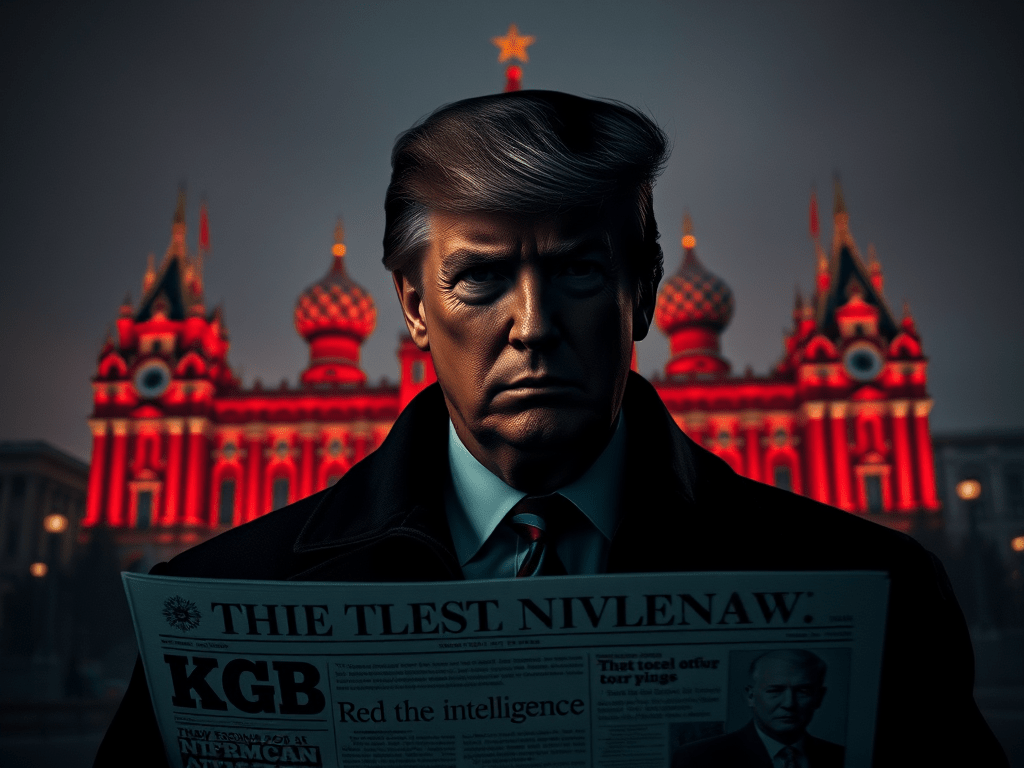
    Recent claims from former intelligence officials suggest that Donald Trump was not merely a businessman enchanted by Moscow’s golden domes but a man recruited by the KGB itself during his 1987 visit to the Soviet capital. Assigned the codename Krasnov, they allege, his ties to Russian intelligence stretch back decades—woven into his first marriage in 1977 and nurtured in the shadows ever since.

    These allegations, put forth by Alnur Mussayev, former head of Kazakhstan’s intelligence service, and echoed by Yuri Shvets, a former KGB major, remain unproven in the strictest legal sense. Investigations like the Mueller Report scrutinized Trump’s orbit, uncovering extensive Russian contacts but stopping short of labeling him an asset. And yet, the absence of proof is not proof of absence.

    What we do know is this:

    • Confirmed interactions between Trump’s associates and Russian operatives: 100%.
    • Verified evidence that Trump directly operated as a Russian asset: 0%.

    But numbers alone do not tell the whole story. The past decade has been defined by a political reality where smoke does not always lead to fire—because the fire may have already done its work, reshaping the landscape before anyone noticed. Russian interference in 2016 is not a matter of debate; it is fact. The deep connections between Trump’s circle and Kremlin-linked figures are documented. The only question that remains is whether the former president himself was merely an unwitting beneficiary—or something far more dangerous.

    To dismiss these allegations outright is to ignore the gravity of the risk they present. If, by some dark twist of fate, these whispers hold even a kernel of truth, then America was not just infiltrated—it was compromised at the highest level. The republic deserves the truth. And until that truth is known, the shadow of Krasnov will linger over history, an unanswered question that threatens to haunt us all.

  • How Do the Ultra-Rich Avoid Paying Their Fair Share of Taxes?

    How Do the Ultra-Rich Avoid Paying Their Fair Share of Taxes?

    The ultra-wealthy use legal strategies to minimize their tax burden, often paying a lower effective tax rate than middle-class earners.

    Common Tax Loopholes Used by the Ultra-Rich

    • Capital Gains vs. Income Tax
      • Wealthy individuals earn most of their income through investments. These are taxed at lower capital gains rates, typically 15-20%. This is lower than the higher income tax rates.
    • Tax-Free Borrowing
      • They take loans against their assets instead of selling them, avoiding taxable events while maintaining liquidity.
    • Offshore Tax Havens
      • Money is stored in foreign accounts or shell companies to shield income from taxation.
    • Pass-Through Entities (LLCs, S-Corps, Trusts)
      • Business structures allow them to shift income and reduce taxable liability.
    • Step-Up in Basis
      • Inherited assets get a tax-free increase in value, allowing heirs to sell without paying capital gains taxes on past appreciation.
    • Charitable Foundations & Donations
      • Donations reduce taxable income, and private foundations allow for control over assets while securing tax benefits.

    These strategies allow the ultra-rich to legally reduce or defer their tax payments significantly.