
Tag: election

  • 11 Historical Moments When U.S. Democracy Was at Risk

    11 Historical Moments When U.S. Democracy Was at Risk

    Throughout its history, the United States has faced moments when democracy came under threat, often due to power consolidation, constitutional crises, or executive overreach. While the system has endured, these episodes serve as critical lessons.

    1. Early Republic and the Alien & Sedition Acts (1798)

    President John Adams signed the Alien and Sedition Acts, suppressing free speech and jailing political opponents. This sparked fears of authoritarianism but was reversed with Thomas Jefferson’s election in 1800.

    2. Andrew Jackson’s “King Andrew” Presidency (1829–1837)

    Jackson expanded executive power, defied the Supreme Court, and centralized control, prompting accusations of dictatorial tendencies. His actions tested the limits of presidential authority but were ultimately checked by institutional resistance.

    3. Civil War and Lincoln’s Emergency Powers (1861–1865)

    Facing secession, Abraham Lincoln suspended habeas corpus and detained thousands without trial. While these measures were temporary and aimed at preserving the Union, they demonstrated how crises can lead to expansive executive authority.

    4. 1876 Election Crisis and the End of Reconstruction

    The disputed election between Rutherford B. Hayes and Samuel Tilden nearly led to a constitutional breakdown. A backroom deal awarded Hayes the presidency in exchange for ending Reconstruction, undermining Black civil rights in the South.

    5. World War I and the Red Scare (1917–1920)

    President Woodrow Wilson’s administration passed the Espionage and Sedition Acts, jailing dissenters and suppressing free speech. This crackdown on civil liberties foreshadowed later abuses during periods of national fear.

    6. FDR’s Court-Packing Plan and Internment Camps (1930s–1940s)

    Franklin D. Roosevelt attempted to expand the Supreme Court to secure favorable rulings, raising fears of executive overreach. During World War II, he also ordered the internment of Japanese Americans—one of the most authoritarian acts in U.S. history.

    7. McCarthyism and the Second Red Scare (1950–1954)

    Senator Joseph McCarthy’s anti-communist crusade led to widespread blacklists, loyalty oaths, and political purges. Though eventually condemned, this period saw significant suppression of dissent and political intimidation.

    8. Watergate Scandal and Nixon’s Abuses (1972–1974)

    President Richard Nixon attempted to cover up illegal activities, used federal agencies against opponents, and fired officials investigating him. The constitutional crisis ended with Nixon’s resignation after the Supreme Court and Congress intervened.

    9. Iran-Contra Affair (1980s)

    The Reagan administration secretly funded Nicaraguan rebels in violation of congressional restrictions, demonstrating how executive power can bypass democratic oversight. Though not leading to dictatorship, it revealed a dangerous disregard for constitutional checks.

    10. Post-9/11 Security State (2001–2008)

    Following the September 11 attacks, the Bush administration expanded executive powers, including warrantless surveillance, indefinite detentions, and the use of torture. While justified as necessary for national security, these actions raised serious concerns about authoritarian drift.

    11. January 6 and the 2020 Election Crisis

    After losing the 2020 election, President Donald Trump falsely claimed voter fraud, pressured officials to overturn results, and incited a mob that stormed the U.S. Capitol. This marked the first direct attempt by a sitting president to disrupt the peaceful transfer of power. Though ultimately unsuccessful, the event exposed the fragility of democratic institutions.

    Conclusion

    At multiple points, the U.S. has faced crises that pushed it toward authoritarianism, often in times of war, economic turmoil, or political division. However, constitutional checks, public resistance, and institutional resilience have so far prevented a permanent descent into autocracy. These historical moments serve as reminders that democracy requires constant vigilance and commitment to uphold its principles.
  • The Fake Electors Plot: Trump’s Electoral College Strategy – Jan 2021

    The Fake Electors Plot: Trump’s Electoral College Strategy – Jan 2021

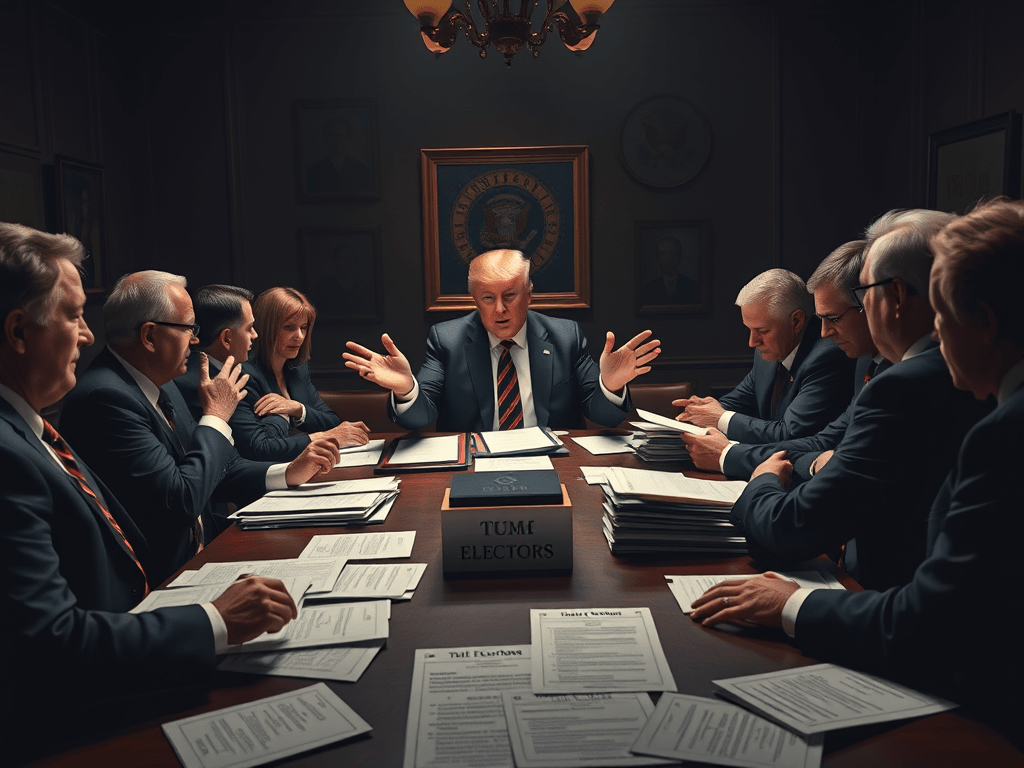
    Following Donald Trump’s loss in the 2020 U.S. presidential election, he and his allies attempted various strategies to overturn the results. One of the most significant efforts was the “fake electors” plot, aimed at subverting the Electoral College process. This scheme involved Republican activists in seven battleground states—Arizona, Georgia, Michigan, Nevada, New Mexico, Pennsylvania, and Wisconsin—who falsely declared themselves as legitimate electors for Trump. These fake elector certificates were submitted to the National Archives and Congress, aiming to create confusion and provide justification for blocking or delaying Biden’s certification on January 6, 2021.

    This effort was coordinated alongside Trump’s legal team’s broader attempts to pressure state officials and Vice President Mike Pence to overturn the election. White House lawyers warned the scheme was unlawful, yet Trump’s inner circle continued pushing it forward, citing dubious legal justifications. Unlike the 1960 Hawaii precedent, where dueling electors were submitted due to an ongoing recount, there were no legitimate legal disputes in 2020 that warranted such actions.

    Key Individuals Involved:

    • Donald Trump: Directly pushed for the scheme, pressuring officials and advocating for fake electors to be counted.
    • Rudy Giuliani: Coordinated efforts with state GOP officials to organize false electors.
    • John Eastman & Kenneth Chesebro: Developed legal arguments and strategies for the scheme, with Chesebro drafting key memos.
    • Mark Meadows: Trump’s Chief of Staff, involved in strategic discussions.
    • Boris Epshteyn & Mike Roman: Played logistical roles, ensuring fake elector certificates were properly submitted.
    • State-Level GOP Officials: Various state Republican leaders and activists participated, signing and submitting the false documents.

    Legal Implications and Charges:

    Authorities at the state and federal levels have investigated and prosecuted those involved. Criminal charges include forgery, conspiracy, fraud, and election law violations. Indictments have been issued in Arizona, Georgia, Michigan, Nevada, and Wisconsin, with Trump himself federally charged in 2023 for conspiring to overturn the election. In some states, fake electors secured immunity deals by cooperating with prosecutors.

    Several key figures, including Chesebro and Giuliani, have been indicted. Chesebro pleaded guilty in Georgia and agreed to testify. Michigan charged 16 fake electors with eight felony counts each, and Arizona indicted 18 individuals, including state GOP officials. In Nevada, six fake electors face felony charges, while Wisconsin targeted the organizers of the scheme rather than the electors themselves.

    At the federal level, Special Counsel Jack Smith’s indictment of Trump in Washington, D.C., highlights the fake electors plot as a core element of a broader conspiracy to defraud the U.S. Trump’s trial, originally scheduled for 2024, remains pending due to legal challenges.

    Investigations and Trials:

    • Congressional Investigation: The House Jan. 6 Committee identified the fake electors plan as central to Trump’s election interference efforts.
    • State-Level Prosecutions: Arizona, Georgia, Michigan, Nevada, and Wisconsin have active cases, with some guilty pleas and upcoming trials.
    • Federal Prosecution: Trump and associates face federal charges, with trials expected in 2024-2025.

    Challenges in prosecution include legal maneuvering by defendants and procedural delays. However, the Electoral Count Reform Act (2022) has since clarified that the Vice President’s role in certifying electoral votes is purely ceremonial, preventing similar attempts in future elections.

    Public and Political Reactions:

    The fake electors plot has divided political opinion. Democrats view it as an attack on democracy and support the prosecutions, while Republicans are split—some defend the electors as a precautionary measure, while others distance themselves. Trump and his allies label the legal actions as politically motivated. Meanwhile, some of the charged electors have continued to run for political office or fundraise, presenting themselves as victims of political persecution.

    The ongoing trials will shape the legacy of this unprecedented scheme. The plot has already led to stricter election laws and heightened awareness of attempts to subvert democracy. Whether additional convictions occur or Trump himself faces legal consequences remains to be seen, but the legal and political fallout will likely influence future elections and governance in the U.S.


    Sources:

    1. House Jan. 6 Committee Final Report
    2. U.S. Department of Justice Indictments (Special Counsel Jack Smith)
    3. Fulton County, Georgia RICO Indictments
    4. Michigan Attorney General Press Releases
    5. Arizona Attorney General Indictments
    6. Nevada State Prosecution Filings
    7. Wisconsin Department of Justice Announcements
    8. Various News Reports (The Washington Post, The New York Times, Politico, CNN)
    9. Congressional Record: Electoral Count Reform Act (2022)
    10. Court Filings and Plea Agreements from Georgia, Arizona, and Michigan Cases

  • Evidence of Trump’s Attempts to Overturn 2020 Election

    Evidence of Trump’s Attempts to Overturn 2020 Election

    There is significant evidence presented in legal cases, investigations, and congressional hearings. These sources suggest Donald Trump attempted to overturn the results of the 2020 U.S. presidential election. Key examples include:

    1. Pressuring State Officials

    • Georgia Call: Trump called Georgia Secretary of State Brad Raffensperger on January 2, 2021. He urged him to “find 11,780 votes.” This was the exact number needed to overturn Biden’s victory in the state. The audio recording of the call was made public.

    2. Fake Elector Scheme

    • Trump and his allies promoted a plan to create false electoral certificates. They aimed to submit these certificates from states where he lost. The certificates falsely declared Trump as the winner. The Department of Justice conducted investigations. Congressional investigations also took place. They uncovered extensive efforts to recruit and organize alternate electors in battleground states like Michigan, Arizona, and Pennsylvania.

    3. Efforts to Involve the Justice Department

    • Trump allegedly pressured the Department of Justice to declare the election corrupt, according to testimony from DOJ officials. Acting Deputy Attorney General Richard Donoghue testified that Trump told him to “just say the election was corrupt.” He also said to “leave the rest to me and the Republican congressmen.”

    4. Attempts to Influence Vice President Mike Pence

    • Trump repeatedly pressured Vice President Mike Pence. He wanted Pence to reject the certification of Electoral College results during the January 6, 2021, joint session of Congress. Pence refused, citing his lack of constitutional authority to overturn the results.

    5. Capitol Riot on January 6, 2021

    • In the lead-up to January 6, Trump publicly urged supporters to come to Washington, D.C., tweeting: “Big protest in D.C. on January 6th. Be there, will be wild!”
    • During his rally that day, Trump encouraged the crowd to “fight like hell.” He urged them to march to the Capitol, where the certification was taking place. Many rioters claimed they acted based on Trump’s statements.

    6. Legal Challenges Without Evidence

    • Trump’s legal team filed more than 60 lawsuits challenging the election results. Many of these lawsuits were dismissed for lack of evidence. Judges, including those appointed by Trump, repeatedly stated that no significant voter fraud occurred.

    7. Congressional and Legal Investigations

    • The House Select Committee on the January 6th Attack released detailed findings. These findings include testimonies and communications. They show coordination between Trump, his advisors, and extremist groups.
    • Several indictments have been filed. These include the Georgia RICO case and federal charges by Special Counsel Jack Smith. They allege Trump was the central figure in a multi-pronged effort to overturn the election.