
Tag: news

  • Did Trump Serve as a KGB Recruit? Exploring Recent Claims

    Did Trump Serve as a KGB Recruit? Exploring Recent Claims

    A Shadow Over the Republic: The Unsettling Allegations Against Trump

    History has a way of whispering its warnings long before the storm arrives. And now, those whispers have turned into something more—a chilling accusation that, if true, would shake the very foundation of American democracy.

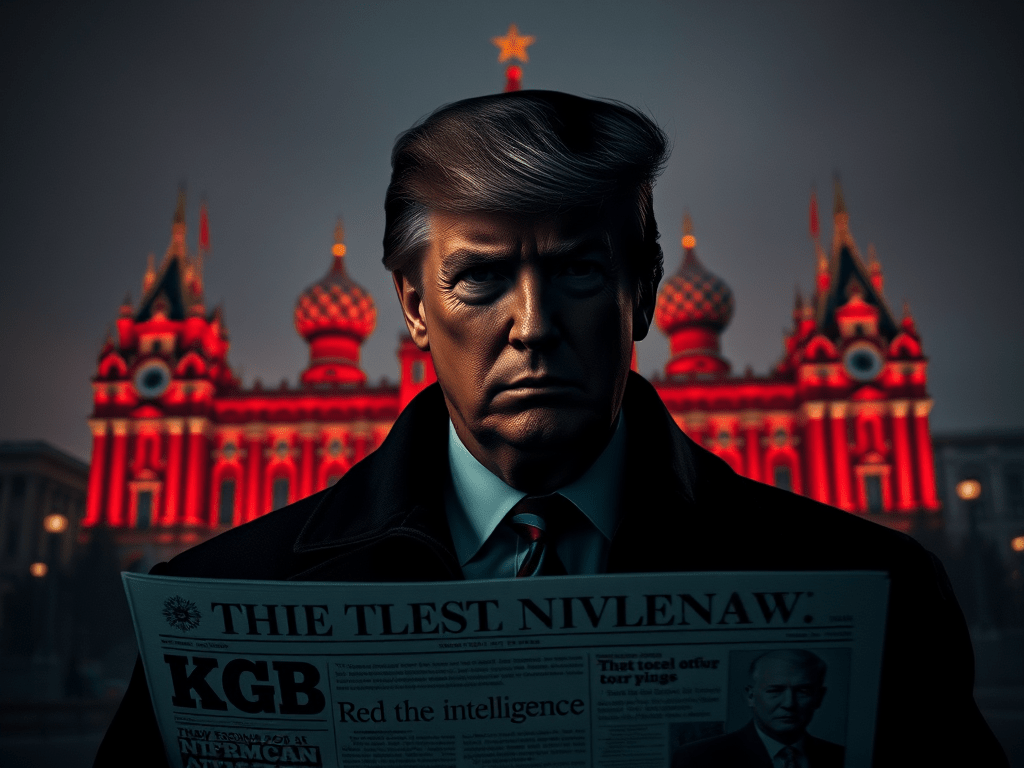
    Recent claims from former intelligence officials suggest that Donald Trump was not merely a businessman enchanted by Moscow’s golden domes but a man recruited by the KGB itself during his 1987 visit to the Soviet capital. Assigned the codename Krasnov, they allege, his ties to Russian intelligence stretch back decades—woven into his first marriage in 1977 and nurtured in the shadows ever since.

    These allegations, put forth by Alnur Mussayev, former head of Kazakhstan’s intelligence service, and echoed by Yuri Shvets, a former KGB major, remain unproven in the strictest legal sense. Investigations like the Mueller Report scrutinized Trump’s orbit, uncovering extensive Russian contacts but stopping short of labeling him an asset. And yet, the absence of proof is not proof of absence.

    What we do know is this:

    • Confirmed interactions between Trump’s associates and Russian operatives: 100%.
    • Verified evidence that Trump directly operated as a Russian asset: 0%.

    But numbers alone do not tell the whole story. The past decade has been defined by a political reality where smoke does not always lead to fire—because the fire may have already done its work, reshaping the landscape before anyone noticed. Russian interference in 2016 is not a matter of debate; it is fact. The deep connections between Trump’s circle and Kremlin-linked figures are documented. The only question that remains is whether the former president himself was merely an unwitting beneficiary—or something far more dangerous.

    To dismiss these allegations outright is to ignore the gravity of the risk they present. If, by some dark twist of fate, these whispers hold even a kernel of truth, then America was not just infiltrated—it was compromised at the highest level. The republic deserves the truth. And until that truth is known, the shadow of Krasnov will linger over history, an unanswered question that threatens to haunt us all.
  • 11 Historical Moments When U.S. Democracy Was at Risk

    11 Historical Moments When U.S. Democracy Was at Risk

    Throughout its history, the United States has faced moments when democracy came under threat, often due to power consolidation, constitutional crises, or executive overreach. While the system has endured, these episodes serve as critical lessons.

    1. Early Republic and the Alien & Sedition Acts (1798)

    President John Adams signed the Alien and Sedition Acts, suppressing free speech and jailing political opponents. This sparked fears of authoritarianism but was reversed with Thomas Jefferson’s election in 1800.

    2. Andrew Jackson’s “King Andrew” Presidency (1829–1837)

    Jackson expanded executive power, defied the Supreme Court, and centralized control, prompting accusations of dictatorial tendencies. His actions tested the limits of presidential authority but were ultimately checked by institutional resistance.

    3. Civil War and Lincoln’s Emergency Powers (1861–1865)

    Facing secession, Abraham Lincoln suspended habeas corpus and detained thousands without trial. While these measures were temporary and aimed at preserving the Union, they demonstrated how crises can lead to expansive executive authority.

    4. 1876 Election Crisis and the End of Reconstruction

    The disputed election between Rutherford B. Hayes and Samuel Tilden nearly led to a constitutional breakdown. A backroom deal awarded Hayes the presidency in exchange for ending Reconstruction, undermining Black civil rights in the South.

    5. World War I and the Red Scare (1917–1920)

    President Woodrow Wilson’s administration passed the Espionage and Sedition Acts, jailing dissenters and suppressing free speech. This crackdown on civil liberties foreshadowed later abuses during periods of national fear.

    6. FDR’s Court-Packing Plan and Internment Camps (1930s–1940s)

    Franklin D. Roosevelt attempted to expand the Supreme Court to secure favorable rulings, raising fears of executive overreach. During World War II, he also ordered the internment of Japanese Americans—one of the most authoritarian acts in U.S. history.

    7. McCarthyism and the Second Red Scare (1950–1954)

    Senator Joseph McCarthy’s anti-communist crusade led to widespread blacklists, loyalty oaths, and political purges. Though eventually condemned, this period saw significant suppression of dissent and political intimidation.

    8. Watergate Scandal and Nixon’s Abuses (1972–1974)

    President Richard Nixon attempted to cover up illegal activities, used federal agencies against opponents, and fired officials investigating him. The constitutional crisis ended with Nixon’s resignation after the Supreme Court and Congress intervened.

    9. Iran-Contra Affair (1980s)

    The Reagan administration secretly funded Nicaraguan rebels in violation of congressional restrictions, demonstrating how executive power can bypass democratic oversight. Though not leading to dictatorship, it revealed a dangerous disregard for constitutional checks.

    10. Post-9/11 Security State (2001–2008)

    Following the September 11 attacks, the Bush administration expanded executive powers, including warrantless surveillance, indefinite detentions, and the use of torture. While justified as necessary for national security, these actions raised serious concerns about authoritarian drift.

    11. January 6 and the 2020 Election Crisis

    After losing the 2020 election, President Donald Trump falsely claimed voter fraud, pressured officials to overturn results, and incited a mob that stormed the U.S. Capitol. This marked the first direct attempt by a sitting president to disrupt the peaceful transfer of power. Though ultimately unsuccessful, the event exposed the fragility of democratic institutions.

    Conclusion

    At multiple points, the U.S. has faced crises that pushed it toward authoritarianism, often in times of war, economic turmoil, or political division. However, constitutional checks, public resistance, and institutional resilience have so far prevented a permanent descent into autocracy. These historical moments serve as reminders that democracy requires constant vigilance and commitment to uphold its principles.

  • Analyzing Trump’s Controversial Pardons: A Justice Debate

    Analyzing Trump’s Controversial Pardons: A Justice Debate

    1. January 6 Capitol Riot Participants:

    On his first day back in office, President Trump issued pardons and commuted sentences for approximately 1,500 individuals connected to the January 6, 2021, Capitol attack. This clemency extended to prominent figures such as:​

    • Stewart Rhodes: Founder of the Oath Keepers.​
    • Enrique Tarrio: Leader of the Proud Boys.​

    Experts in counter-terrorism have expressed concerns that these actions might embolden future political violence. Legal scholars and Justice Department officials have criticized the pardons as unprecedented and potentially undermining the integrity of federal law enforcement and the justice system. ​

    2. Ross Ulbricht:

    On January 21, 2025, President Trump granted a full and unconditional pardon to Ross Ulbricht, the founder of the darknet marketplace Silk Road. Ulbricht had been serving a life sentence without parole since 2015 for charges including drug trafficking, money laundering, and computer hacking. This pardon fulfilled a campaign promise Trump made during his speech at the Libertarian National Convention. ​

    3. Anti-Abortion Activists:

    On January 23, 2025, President Trump pardoned 23 anti-abortion protesters convicted of violating the Freedom of Access to Clinic Entrances (FACE) Act. Among those pardoned was Lauren Handy and nine co-defendants involved in the October 2020 blockade of a Washington, D.C., abortion clinic. Critics argue that these pardons signal the administration’s opposition to abortion access and may encourage further disruptive protests. ​

    4. Brian Kelsey:

    Former Tennessee state Senator Brian Kelsey, who had been serving a 21-month prison sentence for campaign finance violations related to his 2016 congressional bid, received a full and unconditional pardon from President Trump. Kelsey had pleaded guilty in 2022 to illegally funneling campaign funds but had unsuccessfully attempted to retract his plea. Critics contend that this pardon undermines accountability and the rule of law. ​

    5. Attempts to Void Biden’s Pardons:

    President Trump announced intentions to void certain pardons granted by former President Joe Biden, alleging they were executed using an autopen—a device that replicates signatures. Legal experts have clarified that autopen-signed pardons are valid under U.S. law, rendering Trump’s assertions legally unfounded.

    These actions have sparked significant debate regarding the use of presidential pardon power and its implications for justice, accountability, and societal norms.

    Sources:

    1. Wikipedia – First 100 Days of the Second Donald Trump Presidency
    2. AP News – Trump Pardons Anti-Abortion Activists
    3. AP News – Trump Pardons Former Tennessee Lawmaker Brian Kelsey
    4. Al Jazeera – Trump’s Attempt to Reverse Biden’s Pardons
    5. The Times UK – Trump Pardons January 6 Convicts