
Tag: trump

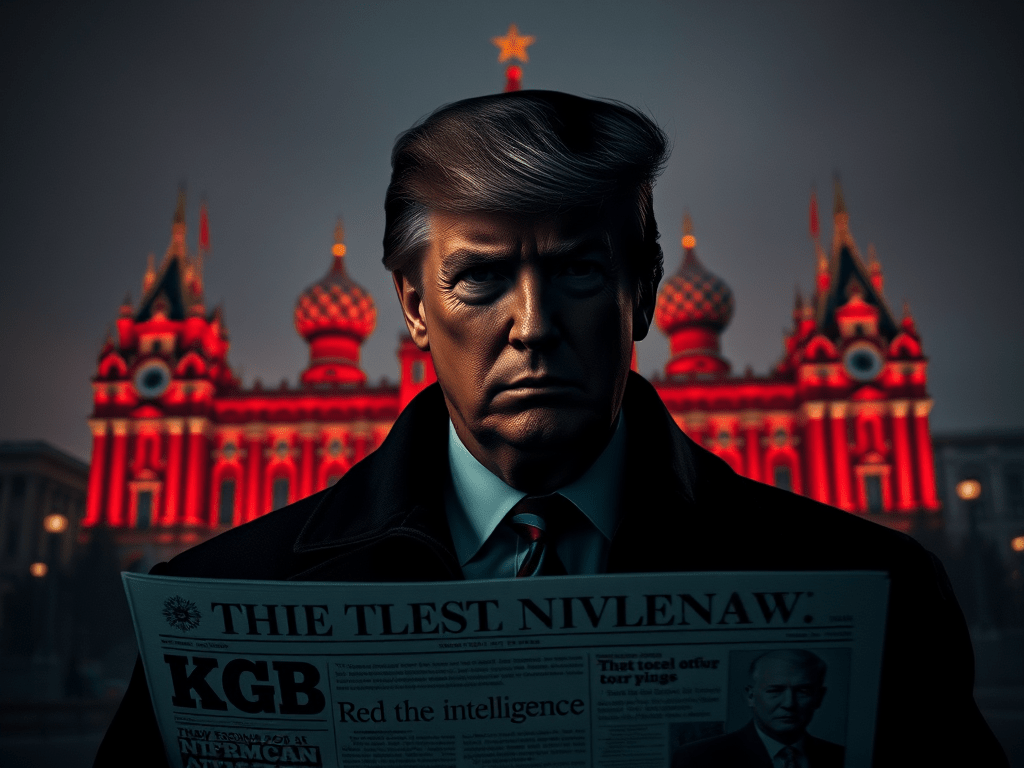
  • Did Trump Serve as a KGB Recruit? Exploring Recent Claims

    Did Trump Serve as a KGB Recruit? Exploring Recent Claims

    A Shadow Over the Republic: The Unsettling Allegations Against Trump

    History has a way of whispering its warnings long before the storm arrives. And now, those whispers have turned into something more—a chilling accusation that, if true, would shake the very foundation of American democracy.

    Recent claims from former intelligence officials suggest that Donald Trump was not merely a businessman enchanted by Moscow’s golden domes but a man recruited by the KGB itself during his 1987 visit to the Soviet capital. Assigned the codename Krasnov, they allege, his ties to Russian intelligence stretch back decades—woven into his first marriage in 1977 and nurtured in the shadows ever since.

    These allegations, put forth by Alnur Mussayev, former head of Kazakhstan’s intelligence service, and echoed by Yuri Shvets, a former KGB major, remain unproven in the strictest legal sense. Investigations like the Mueller Report scrutinized Trump’s orbit, uncovering extensive Russian contacts but stopping short of labeling him an asset. And yet, the absence of proof is not proof of absence.

    What we do know is this:

    • Confirmed interactions between Trump’s associates and Russian operatives: 100%.
    • Verified evidence that Trump directly operated as a Russian asset: 0%.

    But numbers alone do not tell the whole story. The past decade has been defined by a political reality where smoke does not always lead to fire—because the fire may have already done its work, reshaping the landscape before anyone noticed. Russian interference in 2016 is not a matter of debate; it is fact. The deep connections between Trump’s circle and Kremlin-linked figures are documented. The only question that remains is whether the former president himself was merely an unwitting beneficiary—or something far more dangerous.

    To dismiss these allegations outright is to ignore the gravity of the risk they present. If, by some dark twist of fate, these whispers hold even a kernel of truth, then America was not just infiltrated—it was compromised at the highest level. The republic deserves the truth. And until that truth is known, the shadow of Krasnov will linger over history, an unanswered question that threatens to haunt us all.
  • 11 Historical Moments When U.S. Democracy Was at Risk

    11 Historical Moments When U.S. Democracy Was at Risk

    Throughout its history, the United States has faced moments when democracy came under threat, often due to power consolidation, constitutional crises, or executive overreach. While the system has endured, these episodes serve as critical lessons.

    1. Early Republic and the Alien & Sedition Acts (1798)

    President John Adams signed the Alien and Sedition Acts, suppressing free speech and jailing political opponents. This sparked fears of authoritarianism but was reversed with Thomas Jefferson’s election in 1800.

    2. Andrew Jackson’s “King Andrew” Presidency (1829–1837)

    Jackson expanded executive power, defied the Supreme Court, and centralized control, prompting accusations of dictatorial tendencies. His actions tested the limits of presidential authority but were ultimately checked by institutional resistance.

    3. Civil War and Lincoln’s Emergency Powers (1861–1865)

    Facing secession, Abraham Lincoln suspended habeas corpus and detained thousands without trial. While these measures were temporary and aimed at preserving the Union, they demonstrated how crises can lead to expansive executive authority.

    4. 1876 Election Crisis and the End of Reconstruction

    The disputed election between Rutherford B. Hayes and Samuel Tilden nearly led to a constitutional breakdown. A backroom deal awarded Hayes the presidency in exchange for ending Reconstruction, undermining Black civil rights in the South.

    5. World War I and the Red Scare (1917–1920)

    President Woodrow Wilson’s administration passed the Espionage and Sedition Acts, jailing dissenters and suppressing free speech. This crackdown on civil liberties foreshadowed later abuses during periods of national fear.

    6. FDR’s Court-Packing Plan and Internment Camps (1930s–1940s)

    Franklin D. Roosevelt attempted to expand the Supreme Court to secure favorable rulings, raising fears of executive overreach. During World War II, he also ordered the internment of Japanese Americans—one of the most authoritarian acts in U.S. history.

    7. McCarthyism and the Second Red Scare (1950–1954)

    Senator Joseph McCarthy’s anti-communist crusade led to widespread blacklists, loyalty oaths, and political purges. Though eventually condemned, this period saw significant suppression of dissent and political intimidation.

    8. Watergate Scandal and Nixon’s Abuses (1972–1974)

    President Richard Nixon attempted to cover up illegal activities, used federal agencies against opponents, and fired officials investigating him. The constitutional crisis ended with Nixon’s resignation after the Supreme Court and Congress intervened.

    9. Iran-Contra Affair (1980s)

    The Reagan administration secretly funded Nicaraguan rebels in violation of congressional restrictions, demonstrating how executive power can bypass democratic oversight. Though not leading to dictatorship, it revealed a dangerous disregard for constitutional checks.

    10. Post-9/11 Security State (2001–2008)

    Following the September 11 attacks, the Bush administration expanded executive powers, including warrantless surveillance, indefinite detentions, and the use of torture. While justified as necessary for national security, these actions raised serious concerns about authoritarian drift.

    11. January 6 and the 2020 Election Crisis

    After losing the 2020 election, President Donald Trump falsely claimed voter fraud, pressured officials to overturn results, and incited a mob that stormed the U.S. Capitol. This marked the first direct attempt by a sitting president to disrupt the peaceful transfer of power. Though ultimately unsuccessful, the event exposed the fragility of democratic institutions.

    Conclusion

    At multiple points, the U.S. has faced crises that pushed it toward authoritarianism, often in times of war, economic turmoil, or political division. However, constitutional checks, public resistance, and institutional resilience have so far prevented a permanent descent into autocracy. These historical moments serve as reminders that democracy requires constant vigilance and commitment to uphold its principles.

  • State of The Union, March 25

    State of The Union, March 25

    As of March 18, 2025, President Donald Trump’s administration has taken several actions. These actions have significantly affected various aspects of U.S. governance. They also affected international relations and domestic policies. Notably, recent developments indicate a potential shift in U.S.-Russia relations, which could have profound implications for longstanding alliances and global stability. ​

    1. Democratic Institutions:

    • Project 2025 Implementation: The administration is advancing “Project 2025.” It is a comprehensive plan aiming to restructure the executive branch. The goal is to align more closely with conservative ideologies. Critics argue that this initiative could undermine checks and balances, centralize power, and erode democratic norms. ​

    2. National Security:

    • Erosion of NATO Commitments: President Trump’s recent statements have cast doubt on the United States’ willingness to uphold NATO’s Article 5 mutual defense clause. They have created uncertainty about America’s commitment. This is particularly concerning for allies not meeting defense spending targets. This ambiguity has raised concerns about the credibility of the U.S. commitment to collective defense and the potential weakening of the alliance. ​
    • U.S.-Russia Engagement: The administration is working to improve relations with Russia. This includes discussions about reducing hostilities in Ukraine. These efforts have unsettled NATO allies. These moves are perceived as a shift away from traditional U.S. foreign policy and have led to apprehension regarding the alliance’s unity and effectiveness. ​

    3. Liberty and Freedom:

    • Assault on Media and Academic Institutions: The administration has taken unprecedented actions against media outlets. It has also targeted academic institutions. These actions include lawsuits against networks. There have been funding cuts to universities hosting protests. Such measures are viewed as attempts to suppress dissent and undermine freedoms of speech and assembly. ​

    4. Economy:

    • Trade Policies and Tariffs: Tariffs have been reintroduced on imports from key trading partners like Canada, Mexico, and China. These actions have led to increased inflation. They have also slowed economic growth. Economists forecast a decrease in U.S. economic growth to 1.6% in 2025, down from 2.3% previously predicted, attributing this slowdown to the administration’s trade policies.

    5. Education:

    • Threats to Academic Freedom: Policies targeting universities, particularly those perceived as opposing administration views, threaten academic freedom. Funding cuts and other punitive measures could stifle open discourse and critical thinking within educational institutions.

    6. Human Health:

    • Healthcare Policy Shifts: Efforts to dismantle existing healthcare frameworks without viable replacements have raised concerns. These concerns include increased uninsured rates and reduced access to medical services. This situation could potentially lead to poorer health outcomes.​

    7. World Peace:

    • U.S.-Russia Negotiations on Ukraine: President Trump’s engagement with President Putin has led to a preliminary agreement to reduce missile and drone attacks in Ukraine. However, the exclusion of Ukraine from direct talks raises concerns. The lack of comprehensive conflict resolution also raises concerns about the effectiveness and sincerity of these efforts. ​

    8. Law and Order:

    • Justice Department Restructuring: The administration is making moves to assert greater control over the Department of Justice. This includes the dismissal of inspectors general. These actions have raised alarms about the potential erosion of judicial independence and the rule of law. ​

    9. Relationships with Allies:

    • Strained NATO Relations: The administration’s unpredictable foreign policy has strained relationships with traditional allies. A perceived pivot toward Russia also contributes to this tension. European leaders express skepticism about the reliability of U.S. security commitments, prompting discussions about increasing defense spending and developing independent defense capabilities.

    In summary, the current administration’s policies and actions have introduced significant shifts in both domestic and international arenas. The potential U.S.-Russia rapprochement poses challenges to established alliances. It could lead to a realignment of global power structures. This has far-reaching implications for democratic institutions, economic stability, and international peace.

    Sources:

    Financial Times
    CBS News
    Vox
    Vanity Fair
    Wikipedia
    Business Insider
    Vanity Fair